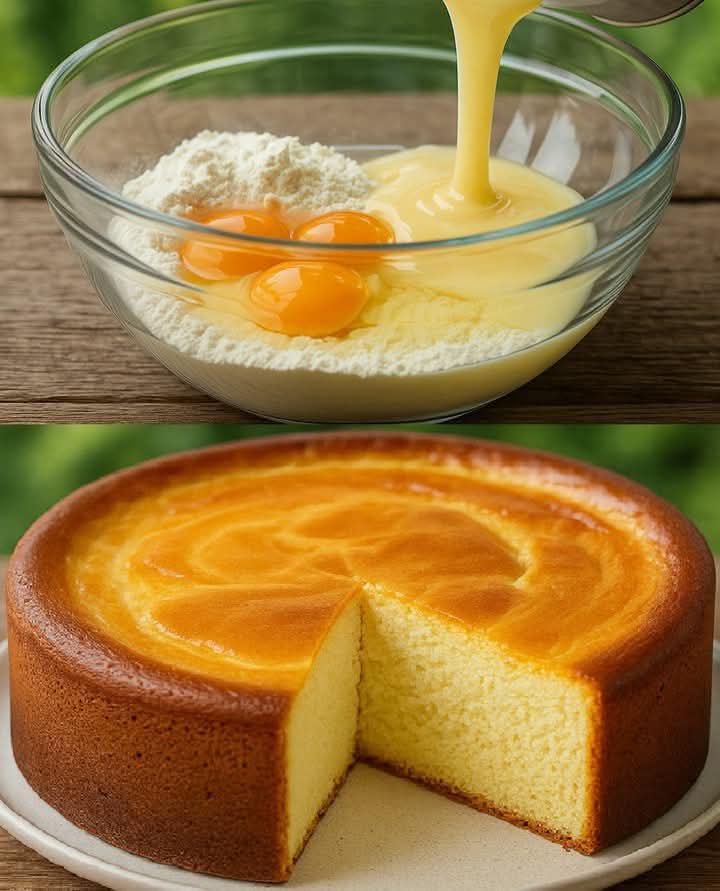
Condensed Milk Cake: The Ultimate Creamy Delight 🍮🎂
Introduction
Imagine a cake that bridges the gap between a fluffy sponge and a silky flan—caramelized on top, dense and moist within, and bursting with milky sweetness. That’s Condensed Milk Cake. With just a handful of pantry staples, this no-fuss dessert delivers a luxurious texture that melts on your tongue. Whether you’re a novice baker or a seasoned pro, this recipe will become a cherished favorite.
Ingredients
Ingredient Quantity Notes
All-purpose flour 1 cup (120g) Sifted for lightness
Sweetened condensed milk 1 can (14 oz / 397g) Full-fat for best texture
Large eggs 3 Room temperature
Unsalted butter 2 tbsp (28g) Melted, for greasing
Vanilla extract (optional) 1 tsp Enhances flavor
Pinch of salt ⅛ tsp Balances sweetness
Optional add-ins: lemon zest, shredded coconut, or a swirl of dulce de leche.
Instructions (Step-by-Step)
1. Preheat & Prepare – Set oven to 350°F (175°C). Grease a 8-inch round or square baking dish with melted butter. Line bottom with parchment for easy release.
2. Whisk Eggs – In a large bowl, beat eggs vigorously until pale and frothy (about 2 minutes).
3. Add Condensed Milk – Pour in the entire can. Whisk until smooth and homogeneous.
4. Fold in Dry Ingredients – Add sifted flour and salt. Gently fold with a spatula until just combined—no lumps, but do not overmix.
5. Transfer to Pan – Pour batter into prepared dish. Tap twice on counter to release air bubbles.
6. Bake – Place in middle rack. Bake for 35–40 minutes. A toothpick inserted near the center should come out clean or with moist crumbs (not wet batter).
7. Cool – Let cake rest in pan for 10 minutes, then invert onto a wire rack. Cool completely.
8. Serve – Slice and enjoy plain, dusted with powdered sugar, or topped with fresh berries.
Methods (First Section – Core Baking Techniques)
· Standard Oven Method – As described above. Provides even heat and a signature golden-brown top.
· Water Bath Method – Place the filled cake pan inside a larger roasting pan. Add hot water halfway up the sides. Bake at 325°F for 50 minutes. This yields an even denser, creamier, flan-like interior.
· High-Altitude Adjustment – Add 2 tbsp extra flour and reduce oven temperature by 15°F to prevent over-rising and collapse.
History
The origin of condensed milk cake traces back to the invention of sweetened condensed milk in 1856 by Gail Borden Jr. (USA). It was a revolutionary shelf-stable dairy product used by soldiers and explorers. By the early 20th century, condensed milk became a baking staple in Latin America, Asia, and Europe.
In Brazil, it inspired bolo de leite condensado—a simple, beloved cake often served with coffee. In the Philippines, similar recipes evolved into mamon variations. During World War II, when fresh milk was scarce, home bakers across the globe turned to condensed milk for sweet treats. Today, this cake is cherished for its nostalgia, affordability, and irresistible texture.
Benefits
· Budget-Friendly – Uses common, inexpensive ingredients.
· No Fancy Equipment – A bowl, whisk, and oven (or even a pressure cooker) are all you need.
· Kid-Approved – Mild, sweet flavor appeals to young palates.
· Versatile Base – Add cocoa powder for chocolate version, or replace flour with almond flour for gluten-free adaptation.
· Long Shelf Life – Condensed milk itself lasts for months; the baked cake stays moist for 3–4 days at room temperature.
· Emotional Comfort – The creamy, caramelized notes evoke warmth and nostalgia.
Formation (The Science Behind the Cake)
Why does this cake turn out so uniquely dense and custardy?
· Condensed Milk – Contains high sugar (≈45%) and milk solids. Sugar inhibits gluten development, resulting in a tender crumb. Milk proteins promote browning via the Maillard reaction, creating the signature caramelized top.
· Eggs – Provide structure (coagulation) and moisture. The fat in yolks enriches texture.
· Flour – A modest amount (1 cup) keeps the cake from becoming bread-like. Too much flour would yield a dry sponge.
· Heat Reaction – During baking, sugar from condensed milk migrates upward, forming a slightly sticky, bronzed crust. Inside, steam from egg moisture creates tiny air pockets, but because there’s no creamed butter or chemical leavening (baking powder), the rise is minimal—hence the dense, fudge-like consistency.
Pro tip: For an even deeper caramel flavor, substitute ¼ cup of the condensed milk with dulce de leche.
Conclusion (First)
Condensed Milk Cake is proof that simplicity can be spectacular. With no mixer, no complicated steps, and no hard-to-find ingredients, you can create a dessert that tastes like it came from a cozy bakeshop. Its humble origins and global journey make every bite a little piece of history.
Lovers (First – Who Adores This Cake?)
· Busy Parents – A quick after-school snack that kids can help make.
· College Students – Dorm-friendly (use a microwave mug version: mix 1 egg, 3 tbsp condensed milk, 3 tbsp flour; microwave 90 seconds).
· Nostalgic Bakers – Reminds them of grandmother’s kitchen.
· Tea & Coffee Drinkers – Pairs perfectly with black coffee or chai.
· Flan Enthusiasts – Those who love the texture of flan but want a cake-like handle.
· Budget-Conscious Home Cooks – Stretches few ingredients into a showstopper.
Methods (Second Section – Alternative Cooking Methods)
Method Instructions Texture Outcome
Air Fryer Pour batter into a small cake pan. Air fry at 320°F for 20–25 minutes. Crisper edges, moist center.
Instant Pot Cover pan with foil, add 1 cup water to pot. Steam on High for 35 minutes, natural release 10 min. Extremely custardy, almost like a pudding cake.
Slow Cooker Place pan inside slow cooker. Add water 1 inch up sides. Cook on High for 2 hours. Very soft, even browning on bottom only.
Microwave (Mug Cake) Mix 3 tbsp flour, 2 tbsp condensed milk, 1 egg, 1 tbsp oil in a mug. Microwave 70–90 seconds. Quick, single-serving spongy cake.
Each method retains the core appeal—milky, sweet comfort—but the texture shifts from fluffy (microwave) to ultra-dense (Instant Pot).
Nutrition (Per Serving – 8 slices)
Nutrient Amount
Calories 310 kcal
Protein 7 g
Fat 9 g (4 g saturated)
Carbohydrates 50 g
Sugar 38 g
Fiber 0.5 g
Calcium 145 mg (14% DV)
Iron 0.8 mg
Note: Using reduced-fat condensed milk lowers calories to ≈270 kcal but yields a less creamy texture.
Dietary considerations – Contains gluten and dairy. For lactose-free version, use lactose-free condensed milk (available online or specialty stores) and plant-based butter.
—
Conclusion (Second)
To bake a Condensed Milk Cake is to embrace a slow, sweet moment in a busy world. Its caramel top gleams like stained glass; each forkful pulls apart with a gentle resistance before dissolving into creamy bliss. Whether you follow the classic oven method or experiment with an air fryer, this recipe delivers joy without complexity. Keep a can of condensed milk in your pantry—you never know when the craving will strike.
Lovers (Second – Global Fans & Occasions)
· Brazilian families – Serve bolo de leite condensado at Sunday lunches, often with a drizzle of calda de chocolate.
· Filipino fiestas – Enjoyed as cake na may condensada, paired with ripe mangoes.
· Indian chai stalls – Some fusion bakeries offer condensed milk cake as a tea cake with cardamom.
· Vintage recipe collectors – Hunt down 1940s cookbooks where this cake first appeared as “Economy Milk Cake.”
· Romantic desserts – Served with strawberries and whipped cream for date nights.
· Holiday buffets – A non-fussy alternative to fruitcake or pie during Christmas.
Once you taste it, you’ll understand why millions of lovers across continents have kept this simple cake alive for generations. Enjoy every caramel-kissed crumb. 🍮🎂