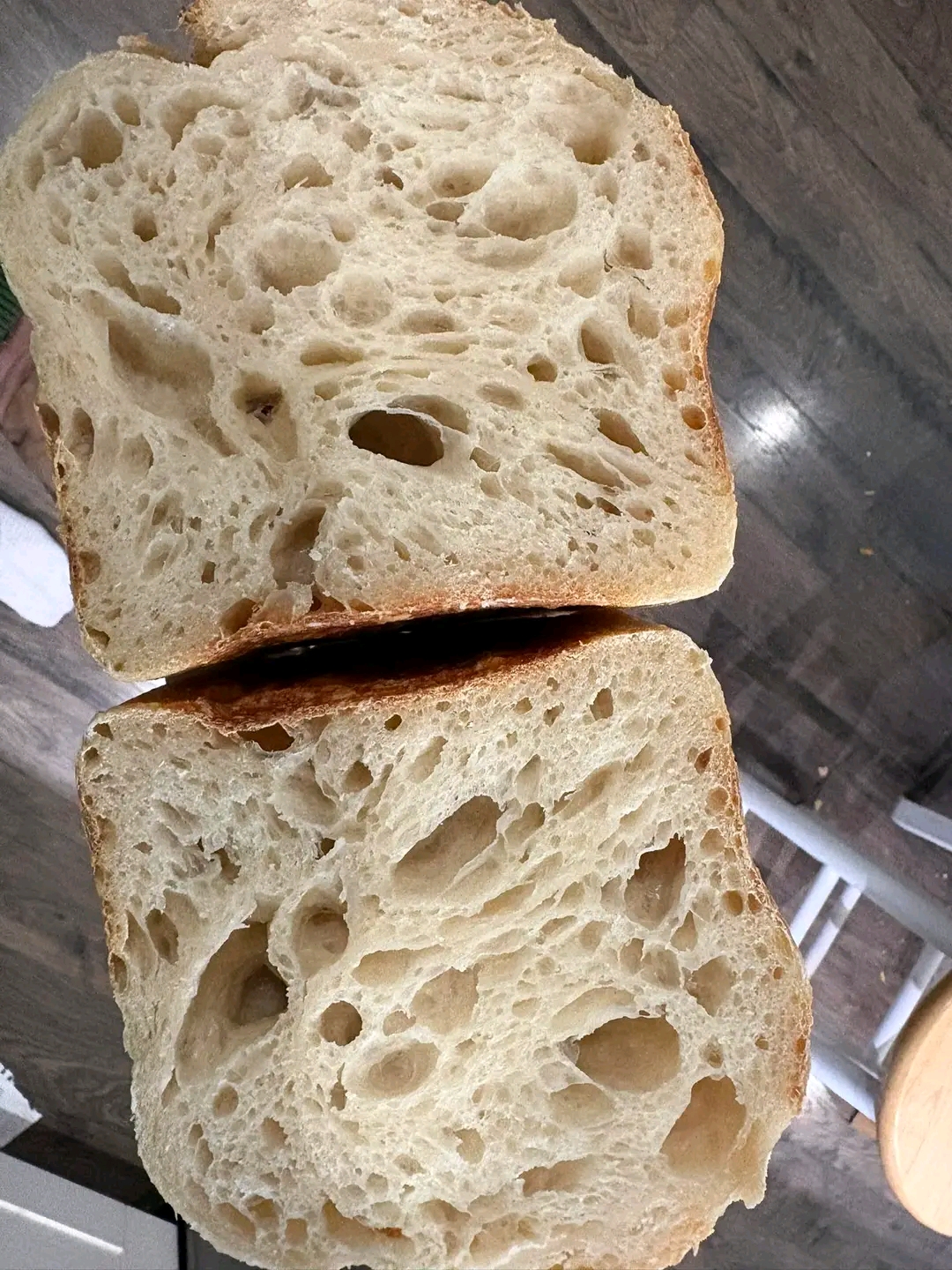
Why My Sourdough Crumb Changed After Switching Starter Maintenance
Help! I changed my starter routine from keeping it in the fridge and feeding it 1:5:5 once a week whenever I baked, to storing it in a starter home at 54°F and feeding it every other day with a
small splash of rye flour. Then, about 12 hours before building my levain, I feed it 1:5:5 again and raise the starter home temperature to 68°F.
Ever since making this change, my bread crumb has become uneven with occasional small tunnels instead of the beautiful even, lace-like open crumb I used to get consistently. I haven’t changed anything else in my process. This loaf was proofed just slightly under fully proofed, so now I’m wondering if the issue is related to hydration, flour absorption, weakened gluten structure, or maybe changes in starter strength and acidity.
After digging deeper, I’m starting to think the starter maintenance changes are likely the main cause.
What Might Be Happening
Keeping the starter at 54°F instead of in the refrigerator changes fermentation behavior significantly. The starter stays more active overall, which can increase acidity and alter the balance between yeast and bacteria. Adding rye flour, even in small amounts, can also speed up fermentation and enzymatic activity.
That combination may lead to:
Increased acidity weakening gluten structure
Faster fermentation than expected
Reduced gas retention
Uneven air pockets and tunneling
Dough becoming more extensible and less elastic
Even though the dough appeared only slightly underproofed, it may actually have been fermenting faster internally than before.
Hydration Could Also Play a Role
Another possibility is that the flour is handling hydration differently because of the warmer and more active fermentation environment. Dough that once felt strong at a certain hydration level may now become looser and harder to organize structurally.
The crumb pattern suggests:
Slight gluten degradation
Uneven fermentation
Gas collecting into isolated pockets instead of distributing evenly
Things I’m Planning to Try
Resetting the Starter
Return temporarily to room-temperature maintenance
Feed consistently without rye for a few days
Watch how quickly the starter peaks and collapses
Adjusting Hydration
Lower hydration slightly by 2–5%
See if the dough regains strength and more even structure
Using the Levain Earlier
Mix dough when the levain is slightly before peak instead of fully peaked
Reduce acid accumulation
Monitoring Dough Temperature
Keep final dough temperature more controlled during bulk fermentation
Avoid excessive warmth speeding up fermentation
Strengthening Gluten Development
Add an extra coil fold during bulk
Focus on gentle but thorough structure building early on
Final Thoughts
The good news is that this doesn’t look like a catastrophic failure — it looks more like a fermentation balance issue caused by the new starter maintenance routine. Since the rest of the process stayed the same, the starter ecosystem is probably the biggest variable.
Sometimes even small changes in temperature, feeding frequency, or flour composition can completely shift crumb structure. A few minor adjustments will likely bring back that beautiful, even, lacy crumb again.