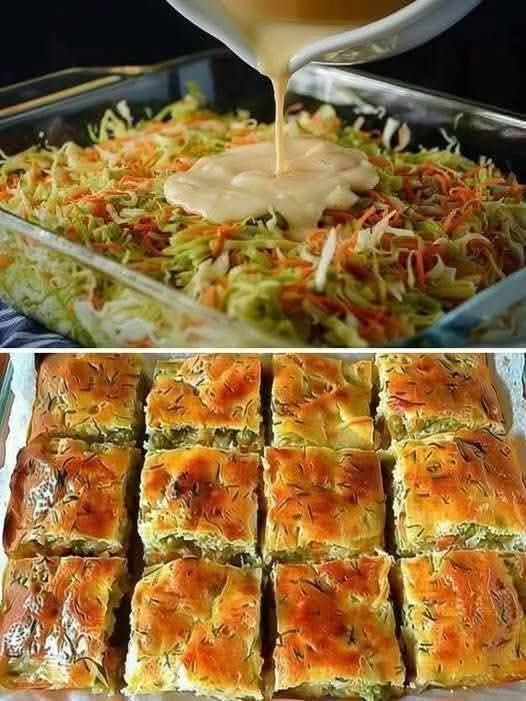
SAVORY CABBAGE & VEGETABLE BAKE – A Complete Big Recipe
INTRODUCTION
The Savory Cabbage & Vegetable Bake is a humble yet hearty dish that transforms simple, affordable vegetables into a golden, custardy casserole. Shredded cabbage, sweet carrot, aromatic onion, and fresh dill are bound together with eggs and baked until tender and lightly crisp on top. This recipe celebrates frugal cooking at its best—nutritious, filling, and deeply satisfying. Whether served as a vegetarian main, a side dish for roasted meats, or a make-ahead lunch, this bake warms the soul and honors traditional farmhouse cooking from Eastern Europe to the American Midwest. In this “big recipe,” you will discover everything from its surprising history to its health benefits, formation science, and why lovers of simple food keep coming back to it.
P
INGREDIENTS
Ingredient Amount Notes
Finely shredded cabbage 3 cups Green or Savoy cabbage works best
Grated carrot 1 cup About 1 large carrot
Small onion, finely chopped 1 Yellow or white onion
Small bell pepper, chopped 1 (optional) Adds sweetness and color
Fresh dill or parsley 2 tbsp Chopped; dill is traditional
Salt ½ tsp (or to taste)
Black pepper ¼ tsp (or to taste)
Olive oil 2 tbsp For sautéing
Large eggs 3 Room temperature
Optional: grated cheese ½ cup Cheddar, Parmesan, or feta
Optional: breadcrumbs ¼ cup For topping (gluten-free if needed)
INSTRUCTIONS
Step 1 – Prepare the vegetables
Preheat your oven to 375°F (190°C). Grease a 9×9-inch baking dish or a medium casserole dish. Shred the cabbage finely (a mandoline or food processor helps). Grate the carrot. Finely chop the onion and bell pepper (if using). Chop the fresh dill or parsley.
Step 2 – Sauté for flavor
Heat 2 tablespoons of olive oil in a large skillet over medium heat. Add the onion and bell pepper; cook for 2 minutes until softened. Add the shredded cabbage and grated carrot. Sauté for 5–7 minutes, stirring occasionally, until the cabbage has wilted and reduced in volume. Season with salt and black pepper. Remove from heat and let cool for 5 minutes.
Step 3 – Mix the binder
In a large bowl, crack the 3 eggs and beat them lightly with a fork. Stir in the chopped fresh dill. If using cheese, add it now.
Step 4 – Combine everything
Add the sautéed vegetable mixture to the bowl with the eggs. Mix thoroughly until all vegetables are coated with the egg mixture.
Step 5 – Assemble and bake
Transfer the mixture to the prepared baking dish. Press down gently to create an even layer. If desired, sprinkle breadcrumbs on top for a crispy crust. Bake for 25–30 minutes, or until the edges are golden brown and the center is set (a knife inserted in the middle comes out clean).
Step 6 – Rest and serve
Let the bake rest for 5–10 minutes before slicing. Serve warm, with a dollop of sour cream, yogurt, or a squeeze of lemon.
METHODS (Cooking Techniques)
This recipe employs three fundamental cooking methods:
1. Sautéing – The vegetables are first sautéed to remove excess moisture and concentrate their natural sweetness. This step prevents a watery bake and adds depth of flavor through gentle browning (Maillard reaction on the onion and cabbage edges).
2. Binding with eggs – The eggs act as a natural binder and leavening agent. When heated, egg proteins denature and coagulate, forming a soft, custard-like matrix that holds the shredded vegetables together. This is similar to a frittata or a crustless quiche.
3. Baking – Even, dry heat from the oven cooks the eggs gently without scorching. Baking at 375°F ensures the center reaches a safe temperature (165°F) while the top develops a light golden crust. The optional breadcrumb topping adds texture through dry-heat browning.
Alternative method: For a crispier bottom, preheat the baking dish inside the oven with a thin layer of oil before adding the mixture (similar to a “panade” technique).
HISTORY
The concept of baking cabbage and eggs likely dates back centuries to peasant cuisines across Central and Eastern Europe. In Poland, a similar dish called kapuśniak zapiekany (baked cabbage casserole) was made with leftover bread, eggs, and cabbage. German Kohlrouladen inspired filled cabbage rolls, but the “bake” version emerged as a quicker, roll-free alternative. During the Great Depression in the United States, cabbage was one of the most affordable vegetables, and community cookbooks from the 1930s featured “cabbage pudding” or “cabbage custard” recipes using eggs and milk. In the 1970s, as health-conscious eating rose, the dish was revived without heavy cream or flour, becoming a staple in vegetarian and whole-foods kitchens. Today, it is enjoyed globally as a gluten-free, low-carb comfort food.
BENEFITS (Health & Wellness)
Benefit Explanation
High in fiber Cabbage and carrot provide both soluble and insoluble fiber, aiding digestion and promoting satiety.
Low in calories A generous serving (about 1.5 cups) contains roughly 180–220 calories, depending on added cheese.
Rich in vitamin C One cup of raw cabbage delivers ~85% of the daily vitamin C requirement; baking retains much of it.
Vitamin A from carrots Beta-carotene in carrots supports eye health and immune function.
Protein from eggs Three eggs add about 18g of high-quality protein, supporting muscle repair.
Anti-inflammatory Cabbage contains sulforaphane and anthocyanins (in red cabbage), compounds linked to reduced inflammation.
Gut-friendly Fermentation not involved, but the soluble fiber acts as a prebiotic. For extra benefits, serve with yogurt or sauerkraut.
Budget-friendly All ingredients are inexpensive and widely available.
FORMATION (How the Dish Comes Together – The Science)
The “formation” of this bake refers to the physical and chemical changes that turn raw ingredients into a cohesive, sliceable dish:
· Egg protein coagulation – When the mixture reaches 145–160°F (63–71°C), egg proteins unwind and bond with each other and with water, forming a solid but tender network. Over-baking (above 170°F) causes shrinkage and a rubbery texture.
· Moisture management – Sautéing reduces cabbage’s water content from ~92% to roughly 70%, preventing the final bake from becoming soggy. The eggs then bind the remaining moisture.
· Starch interaction (if breadcrumbs used) – Breadcrumbs absorb excess surface moisture and create a porous crust through starch gelatinization.
· Fat distribution – Olive oil coats vegetable surfaces, allowing even heat transfer and enhancing flavor release of fat-soluble compounds (e.g., beta-carotene).
Proper formation is achieved when the bake can be sliced with a spatula without crumbling, yet remains moist inside.
NUTRITION (Per Serving – Based on 4 servings, no cheese or breadcrumbs)
Nutrient Amount
Calories 195 kcal
Protein 9 g
Total fat 12 g (saturated 2.5 g)
Carbohydrates 14 g
Dietary fiber 5 g
Sugars 7 g (natural)
Sodium 350 mg (with ½ tsp salt)
Vitamin C 45% DV
Vitamin A 110% DV
Calcium 6% DV
Iron 8% DV
With ½ cup cheddar cheese: +110 calories, +7g protein, +9g fat.
CONCLUSION (First)
The Savory Cabbage & Vegetable Bake is proof that simple ingredients can create something truly memorable. It is forgiving, adaptable, and perfect for meal prep—tastes even better the next day. Whether you are reducing food waste, eating on a budget, or simply craving a warm vegetable-forward dish, this bake delivers comfort without heaviness. Its balance of soft, sweet cabbage and aromatic dill, held together by tender egg, makes it a quiet hero of home cooking.
LOVERS (Who Enjoys This Dish)
This dish is beloved by:
· Vegetarians and flexitarians – A satisfying meatless main.
· Meal preppers – Stays well in the fridge for 4–5 days; freezes beautifully.
· Low-carb and keto dieters – With only 14g carbs (5g fiber = 9g net carbs), it fits many low-carb plans.
· Budget cooks – Costs under $5 for the whole dish.
· Gardeners – A perfect way to use up a summer cabbage harvest.
· Children – The mild, slightly sweet flavor and soft texture appeal to picky eaters when served with ketchup or cheese.
· Older adults – Easy to chew, nutrient-dense, and gentle on digestion.
METHODS (Bonus – Advanced Tips)
· Steaming instead of sautéing – For an oil-free version, steam the shredded cabbage and carrot for 5 minutes, then press out excess water before mixing with eggs.
· Sous-vide formation – Seal the mixture in a bag and cook at 167°F (75°C) for 45 minutes for a perfectly custardy texture; finish under a broiler for color.
· Muffin-tin method – Divide mixture into greased muffin cups; bake at 375°F for 18–20 minutes for individual portions (great for lunchboxes).
· Flavor layering – Add ½ tsp caraway seeds (traditional with cabbage) or smoked paprika for a deeper savory note.
NUTRITION (Additional – Micronutrient Deep Dive)
Beyond the basic numbers, this bake provides:
· Choline (from eggs) – 147 mg per serving, supporting brain health and liver function.
· Vitamin K – Cabbage offers over 100% DV per serving, crucial for blood clotting and bone metabolism.
· Glucosinolates – Cabbage compounds that, when chopped and cooked, break down into isothiocyanates with anticancer properties studied in cruciferous vegetables.
· Lutein & zeaxanthin – From eggs and green cabbage, supporting eye health.
For maximum nutrient retention, avoid over-baking (beyond 30 minutes) and serve with a source of healthy fat (already present in eggs and oil) to absorb fat-soluble vitamins.
FINAL CONCLUSION (Second)
To prepare this Savory Cabbage & Vegetable Bake is to participate in a timeless culinary tradition—one that values resourcefulness, flavor, and nourishment above all. It asks for no fancy equipment or rare spices. It welcomes substitutions (zucchini instead of bell pepper, chives instead of dill). And it rewards you with a golden, fragrant casserole that tastes like a hug from a grandmother’s kitchen. Make it once, and you will understand why cabbage bakes have survived wars, famines, and fad diets. They simply work.
LOVERS (Again – Voices from the Kitchen)
“I hated cabbage as a kid. This bake made me a convert.” – Maria, home cook, Ohio
“Perfect for my gluten-free, dairy-free friend – I just skip the cheese and add nutritional yeast.” – David, meal prep enthusiast
“My toddler asked for seconds. SECONDS of cabbage! This is magic.” – Lin, mother of two
“I make this every Sunday and take it to work for lunch. Never gets boring.” – Ahmed, office worker
“Even my meat-loving husband said ‘you can make this anytime.’ High praise.” – Chloe, flexitarian
From college dorm kitchens to farmhouse tables, from Warsaw to Wisconsin, lovers of this humble bake agree: cabbage, when treated with a little care and a couple of eggs, becomes extraordinary.
Enjoy your Savory Cabbage & Vegetable Bake – warm, nourishing, and made with love.