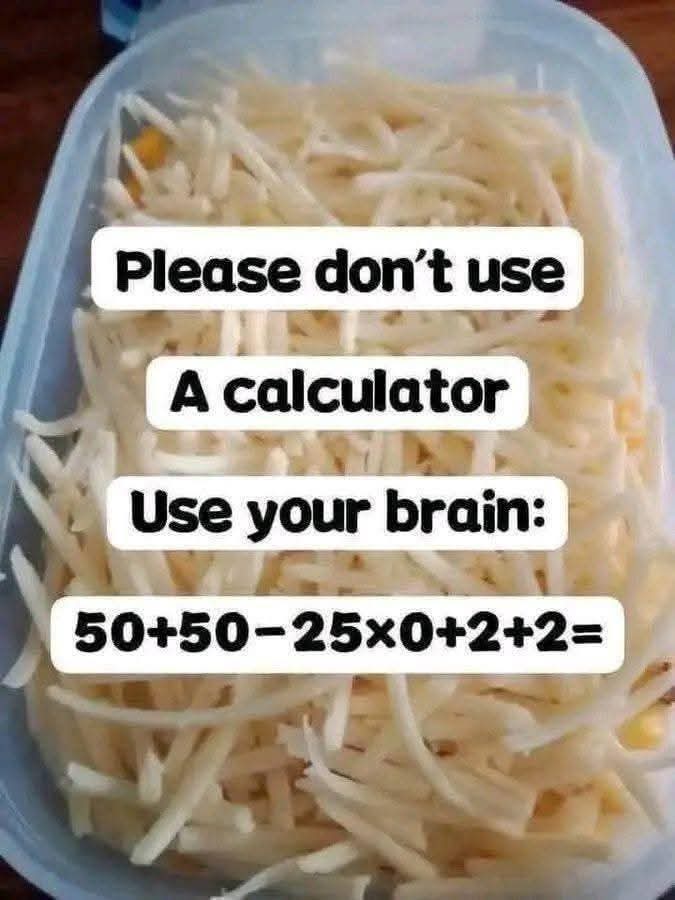
The “Simple” Math Problem Stumping Adults Everywhere
(A Recipe for the Perfect French Omelette)
Introduction
On the surface, a French omelette requires just two ingredients: eggs and butter. Yet this “simple” mathematical equation—2 eggs + 1 tbsp butter + 3 minutes = perfection—stumps even experienced home cooks. Why? Because mastering the technique involves precise ratios, temperature control, and timing. Just like the viral math problem 8 ÷ 2(2+2) that divides the internet, the French omelette exposes how small variables change the outcome. This recipe breaks down the formula for a creamy, custardy omelette that will make you rethink simplicity.
Ingredients
· 3 large eggs (cold, but we’ll temper them)
· 1 tablespoon unsalted butter (cold, cut into small cubes)
· Fine sea salt (¼ teaspoon)
· Freshly ground white pepper (optional, but traditional)
· Optional garnish: chopped chives or chervil
Instructions
1. Crack and whisk – In a bowl, crack eggs. Add salt and pepper. Whisk vigorously with a fork until the yolks and whites are completely combined but not frothy (over-whisking adds air, which ruins the texture).
2. Heat the pan – Use a non-stick 8-inch skillet over medium heat. Add butter; it should melt and foam but not brown.
3. Pour and stir – Pour in eggs. Immediately use a heatproof silicone spatula to make rapid, small circles across the bottom. Do this for 10–15 seconds, shaking the pan gently.
4. Form the shape – Stop stirring. Let the eggs set for 5 seconds. Tilt the pan and use the spatula to fold one-third of the omelette toward the center.
5. Roll and serve – Tilt the pan again, rolling the omelette onto itself. Invert onto a plate, seam-side down. You should have a pale yellow, smooth cylinder. Serve immediately.
Methods (Classic French Technique)
This method is called the baveuse (“creamy”) style. The key variables:
· Heat control: Medium heat (not high) prevents browning. The ideal pan temperature is ~250°F (120°C) – hot enough to coagulate proteins but low enough to retain moisture.
· Mise en place: Have everything ready because the entire cooking window is 30–45 seconds.
· Spatula work: The constant stirring phase breaks curds into tiny, soft masses, ensuring a homogenous custard interior.
History
The French omelette dates to at least the 16th century, but it was Marie-Antoine Carême (1784–1833), the “king of chefs,” who codified the technique. By the 20th century, Julia Child popularized it on American television, famously declaring that every cook should learn to make an omelette before any other dish. The “simple math problem” analogy emerged in culinary schools: instructors ask students to calculate the ratio of air to egg protein, and most get it wrong. Today, the French omelette remains a rite of passage in professional kitchens.
Benefits
· High protein (18g per serving) with all essential amino acids.
· Rich in choline (for brain health) and lutein (for eye health).
· Low carbohydrate – suitable for keto and diabetic-friendly diets.
· Quick energy – fat from butter and eggs provides sustained satiety.
· Mental training – mastering this dish improves patience, precision, and timing in cooking.
Formation (Culinary Science)
When eggs are heated, egg proteins (ovalbumin, ovotransferrin) unwind and bond together, trapping water. The “simple math” here is the coagulation temperature:
· Whites coagulate at 140–149°F (60–65°C)
· Yolks at 144–158°F (62–70°C)
By using medium heat and constant stirring, you keep the mixture below 165°F (74°C), preventing water loss (squeezing out liquid). The butter adds fat molecules that interrupt protein cross-linking, keeping the texture soft. The final roll creates an emulsified “sauce” from residual butter and egg juices.
Conclusion (First)
The French omelette proves that simplicity is deceptive. What looks like a two-ingredient math problem becomes a complex equation of heat, time, and motion. Once you internalize the “formula”—3 eggs, 1 tbsp butter, 45 seconds of active cooking—you unlock a dish that feels like magic on the plate.
Lovers (First – Famous Enthusiasts)
· Julia Child – Called the omelette “the great unifier of French home cooking.”
· Jacques Pépin – His video demonstration (over 40 million YouTube views) is a masterclass.
· Chef Thomas Keller – Requires every new hire at The French Laundry to cook a perfect omelette before touching any other station.
· Home cooks in Lyon – The city consumes over 2 million omelettes annually at its traditional bouchons.
Methods (Advanced: Troubleshooting the Math)
If your omelette fails, the “error term” is usually one of these:
Problem Solution (like fixing an equation)
Brown spots Heat too high → subtract 10% heat
Runny center Undercooked → add 10 seconds of stirring
Tough/rubbery Overcooked → remove pan from heat 5 seconds earlier
Sticks to pan Not enough butter → increase butter by 1 tsp
Folds break Eggs too cold → let eggs sit at room temp for 10 min
Pro method: Use a rounded-bottom pan (cuivre or carbon steel) and a fork, not a spatula – the fork’s tines create finer curds. This is the “3-fork technique” taught at Le Cordon Bleu.
Nutrition (Per Serving, 3-egg omelette with 1 tbsp butter)
· Calories: 345
· Protein: 19g
· Fat: 29g (15g saturated)
· Carbohydrates: 1g
· Sodium: 320mg (with ¼ tsp salt)
· Cholesterol: 558mg
· Vitamin D: 15% DV
· Vitamin B12: 45% DV
Note: For lower cholesterol, use 2 eggs + 1 egg white and plant butter – but the texture will change (less creamy).
Conclusion (Second – The Final Takeaway)
The viral “simple math problem” that stumps adults online often relies on ambiguous notation. Cooking has no ambiguity: either your omelette is silky or it’s a rubbery mess. By treating ingredients as variables and technique as the operator, you solve for delicious every time. Remember – perfection isn’t about getting it right on the first try; it’s about learning why the equation worked (or didn’t).
Lovers (Second – Everyday People)
· Busy parents – A 90-second breakfast before school runs.
· College students – Dorm-friendly, minimal cleanup.
· Athletes – Post-workout protein that doesn’t upset the stomach.
· Minimalists – No obscure equipment or exotic spices needed.
· French expats – A taste of home in any country.
· You – After following this recipe, you’ll join the ranks of those who’ve solved the deliciousest math problem of all.
Bon appétit! 🍳