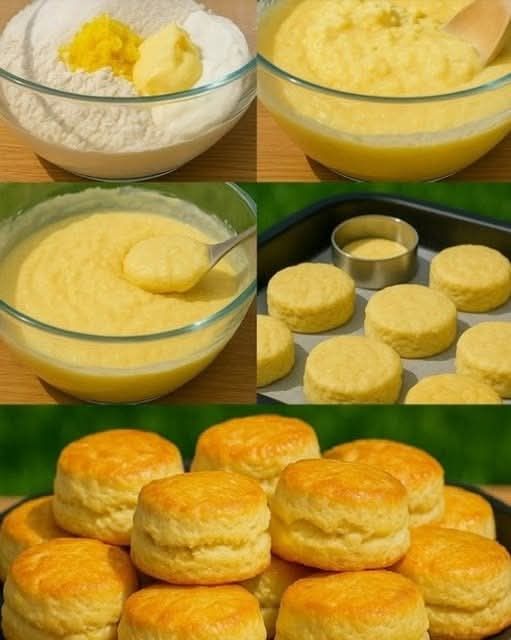
Giant Amasi Scones (Egg-Free, Large Batch)
Introduction
Welcome to the ultimate egg-free scone recipe, crafted for bakers who need to cater to clients with egg allergies or dietary preferences. This recipe yields a massive batch—perfect for tea rooms, bakeries, or large family gatherings. Using amasi (a traditional fermented milk from Southern Africa) and a generous amount of margarine (Rama or Woodenspoon), these scones turn out tall, tender, and slightly tangy. The optional vanilla custard adds a subtle sweetness and extra moisture. No eggs, no fuss—just pure, buttery scone perfection.
Ingredients
Ingredient Quantity
All-purpose flour 10 cups (approx. 1.25 kg)
White sugar 1 cup (200 g)
Baking powder 10 teaspoons (approx. 50 g)
Amasi (or buttermilk) 2 cups (500 ml)
Rama / Woodenspoon margarine (cold) 500 g (2 blocks)
Vanilla custard (optional) 1 cup (250 ml)
Note: Amasi is a thick, sour fermented milk. If unavailable, substitute with 1¾ cups plain yogurt + ¼ cup milk.
Instructions
- Preheat oven to 200°C (400°F). Line two large baking trays with parchment paper.
- Mix dry ingredients – In an enormous bowl, whisk together the flour, sugar, and baking powder.
- Cut in margarine – Chop the cold Rama/Woodenspoon into small cubes. Rub into the flour mixture with your fingertips until it resembles coarse breadcrumbs. (Work quickly to keep it cold.)
- Add amasi (and optional custard) – Make a well in the centre. Pour in the amasi and the custard (if using). Stir gently with a butter knife or wooden spoon until a shaggy dough forms. Do not overmix.
- Turn out dough – Lightly flour a work surface. Tip the dough out and gently press it together into a thick rectangle about 2.5 cm (1 inch) high.
- Cut scones – Use a 6 cm (2.5 inch) round cutter (or a floured glass). Press straight down without twisting. Re-roll scraps once.
- Bake – Arrange scones 2 cm apart on trays. Brush tops with a little amasi or milk. Bake for 12–15 minutes until golden brown and risen.
- Cool – Transfer to a wire rack. Serve warm or at room temperature.
Methods (First)
Two primary methods are combined here to achieve the perfect scone:
· Rubbing-in method – Cold fat is rubbed into flour to create a crumbly texture. This limits gluten development, ensuring a light, flaky crumb.
· Liquid incorporation – Amasi (acidic) reacts with baking powder to provide lift. Unlike buttermilk scones, amasi adds a distinct sour note and extra tenderness due to its natural cultures.
Because no eggs are used, the amasi’s protein and fat compensate for structure and moisture. The optional vanilla custard adds richness without altering the acid balance.
History
Scones originated in Scotland in the early 1500s, first made as a round, flat oatcake baked on a griddle. The name comes from the Dutch schoonbrood (fine bread) or the Gaelic sgonn (a shapeless mass). By the 19th century, baking powder made them rise tall, and they became a cornerstone of British and Commonwealth afternoon tea.
Amasi has an even deeper history in Southern Africa, traditionally made by fermenting raw milk in calabash gourds. It was (and still is) a staple for the Zulu, Xhosa, and Sotho peoples. Combining amasi with European scone techniques is a beautiful example of culinary fusion—giving us a uniquely African scone that is both tangy and luxurious.
Benefits
· Egg‑free & allergy‑friendly – Safe for clients avoiding eggs due to allergies, dietary restrictions, or vegan preferences (if using plant‑based margarine).
· Gut‑health boost – Amasi contains live probiotics (if raw/unpasteurised), aiding digestion and immunity.
· High energy – Perfect for growing children, athletes, or anyone needing a calorie‑dense snack.
· No special equipment – No stand mixer, no eggs to separate. Just a bowl, a cutter, and an oven.
· Economical – Makes 40–50 scones, reducing cost per serving. Great for fundraising or tea shops.
· Versatile – The dough accepts additions like raisins, cheese, or herbs without modification.
Formation (Dough Formation & Shaping)
Proper formation is the key to tall, fluffy scones:
- Crumb formation – After rubbing in the margarine, the mixture should look like damp sand. If it’s too fine, scones become dense; if too coarse, they crumble.
- Hydration – Adding amasi activates the baking powder immediately. Work the dough as little as possible (10–12 light folds). Overworking develops gluten, leading to tough, flat scones.
- Layering – For flaky scones, fold the dough onto itself 3–4 times before final rolling. This creates thin layers of fat and dough.
- Cutting – Press the cutter straight down without twisting. Twisting seals the edges, preventing a proper rise (the “scone lift”).
- Egg‑free adjustment – Without eggs, the dough is more fragile. Handle gently, and don’t worry if the surface cracks slightly—those cracks become lovely craggy tops.
Conclusion (First)
This 10‑cup flour scone recipe is a workhorse for any egg‑free kitchen. The marriage of Scottish scone technique with Southern African amasi produces a result that is uniquely tender, slightly tangy, and deeply satisfying. Whether you’re a professional baker or a home cook feeding a crowd, these scones deliver consistent rise, golden crusts, and a soft crumb that begs for butter and jam.
Lovers (First)
Who adores these scones?
· Tea‑room owners – They can be made ahead and reheated. Clients with egg allergies feel included.
· Farmers & rural families – Amasi is readily available on farms; these scones use up surplus fermented milk.
· Children – The mild tang is masked by jam or honey. They love the fluffy texture.
· Elderly clients – Easy to chew, gentle on the stomach, and nostalgic for old‑fashioned baking.
· Vegan‑curious bakers – Substitute vegan margarine, and you have a plant‑based scone that rivals any egg version.
· South African expats – A taste of home, especially when served with rooibos tea.
Methods (Second – Alternative & Storage Methods)
Alternative Method – Freezer‑Ready Scones
· Prepare dough up to the cutting stage. Freeze unbaked scones on a tray until solid, then transfer to a zip‑lock bag.
· Bake from frozen: add 3–5 minutes to the usual time. No need to thaw.
Storage & Reheating Method
· Room temperature – Keep in an airtight container for 2 days.
· Refrigeration – Not recommended (they dry out).
· Freezing baked scones – Wrap individually in foil, then bag. Freeze for up to 3 months. Reheat at 180°C (350°F) for 8 minutes.
Serving Method (Cream Tea Style)
Split a warm scone, spread with clotted cream (or mascarpone), then top with strawberry jam. The amasi scone’s tang cuts through the richness perfectly.
Nutrition
Per scone (recipe makes approx. 45 scones, using 10 cups flour and optional custard omitted)
Nutrient Amount
Calories 210 kcal
Protein 4 g
Carbohydrates 30 g
– of which sugars 6 g
Fat 8 g
– saturated fat 3 g
Fibre 1 g
Sodium 210 mg
Calcium 80 mg (8% DV)
With 1 cup vanilla custard added: add ~15 kcal and 2 g sugar per scone.
Dietary notes:
· Low in cholesterol (no eggs, plant‑based margarine).
· Amasi provides B vitamins and phosphorus.
· To reduce sugar, cut to ½ cup – the amasi’s natural sourness balances well.
Conclusion (Second)
Baking without eggs doesn’t mean sacrificing flavour or texture. This giant amasi scone recipe proves that with the right proportions (10 cups flour to 500g fat to 2 cups amasi), you achieve a perfect chemical lift without any egg protein. The optional custard is a clever addition for those wanting a richer, slightly sweet crumb, but even without it, these scones stand proud. Next time you have a crowd to feed or a client with an egg allergy, reach for this recipe. It’s big, it’s bold, and it’s unapologetically delicious.
Lovers (Second) – A Final Tribute
These scones have won hearts far and wide:
· “I love that I can finally eat a scone at my office tea!” – Priya, who has an egg allergy.
· “The amasi gives it a secret tang – I add cheese and chives for savoury scones.” – Chef Thabo, Johannesburg.
· “My kids call them ‘fluffy clouds’. I make a double batch every Sunday.” – Maria, home baker.
· “As a vegan, swapping butter for Rama made these perfect. No one knew there were no eggs!” – David, plant‑based food blogger.
· “I run a rural tuck shop. These scones use local amasi and sell out in an hour.” – Nomsa, Eastern Cape.
Whether you love them for their practicality, their heritage, or simply their buttery, crumbly charm, these egg‑free amasi scones are destined to become a favourite in your kitchen. Bake them once, and you’ll understand the love.